
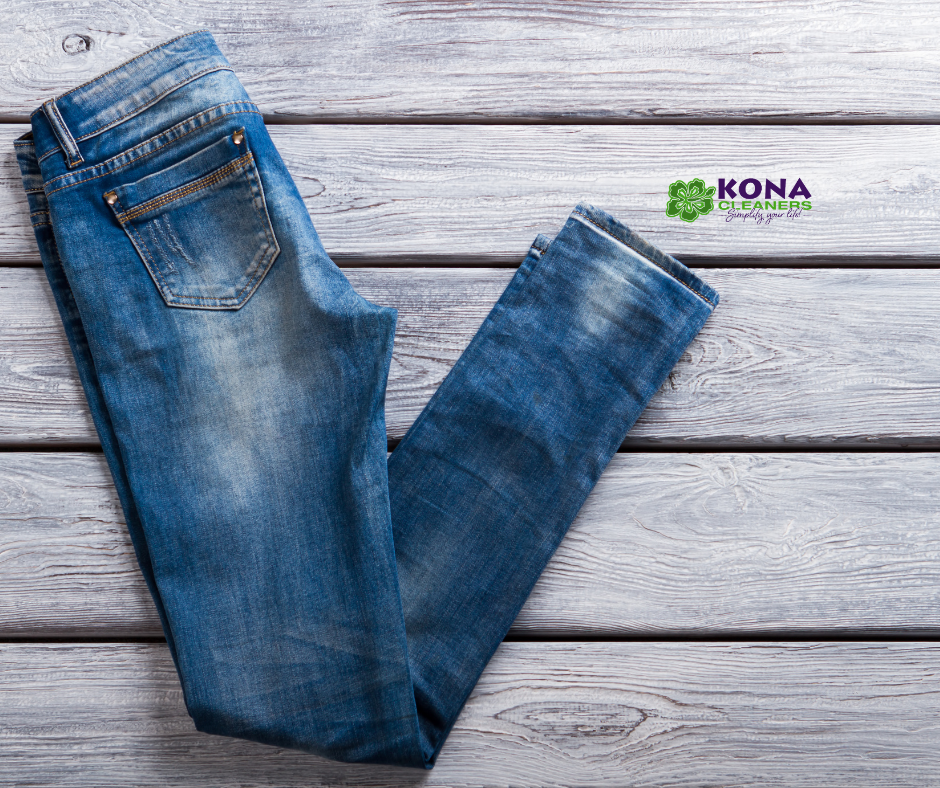
You buy a new pair of jeans because they fit well and the wash is perfect. They are not bargain-bin cheap, but they are not designer either. After wearing them only a few times, you start to notice something that feels slightly disappointing.
There is a faint line across the thigh. Maybe a slightly fuzzy patch near the pocket. Perhaps a strip of fabric that looks like it’s beginning to pill.
Suddenly, your new jeans look worn, and you cannot quite figure out why.
At that point, you start wondering what happened. Are you harder on your clothes than you realized? Or are clothes simply made differently now?
When New Jeans Look Worn After Just a Few Wears
The truth is, most modern jeans are no longer 100 percent cotton. Especially in the mid-range or fast-fashion category, denim is usually a blend. Cotton is mixed with elastane for stretch and sometimes polyester for structure, while shorter cotton fibers are often used to reduce production costs.
That stretch makes jeans far more comfortable than older denim ever was. However, it also changes how the fabric behaves over time.
Blended fibers do not respond to friction the same way as thicker, old-school cotton denim did. As you sit, walk, bend, and move throughout the day, those fibers shift and rub against each other. In high-contact areas like thighs and hips, that movement can appear quickly as faint lines or light pilling.
In many cases, what you are seeing is not actual damage but the fabric settling into its true structure.
The $30 Question
A $30 pair of jeans today is not built with the same materials or manufacturing standards as denim from decades ago. Production moves faster, fabric is often lighter, and fibers are frequently shorter. The focus is usually comfort, trend, and price point rather than a ten-year lifespan.
That does not automatically mean your jeans are poorly made. It simply means they were designed with different priorities.
A softer hand feel often comes from looser surface fibers, while stretch content introduces tension within the weave. As a result, jeans can feel amazing the first time you wear them, but subtle signs of wear may appear sooner than expected.
Why New Jeans Look Worn So Quickly
New denim goes through a natural breaking-in phase. Even without heavy wear, the fabric begins to relax. Stretch fibers adjust, and the tension created during manufacturing starts to settle.
If the cotton fibers are shorter, which is common in lower-cost production, they can lift slightly with everyday friction. That is when you begin to see faint pilling or soft texture lines.
It is not necessarily that your jeans are falling apart. Instead, the surface fibers are revealing how the fabric was constructed in the first place.
In other words, your jeans are no longer in their pristine, straight-off-the-rack state. They are adjusting to real life.
So, Is It Ruined?
Most of the time, the answer is no.
Surface pilling can often be gently removed, and minor tension lines may stabilize after a few washes. In many situations, what appears to be weakness is purely cosmetic.
What matters more is how you care for the jeans moving forward.
High heat, frequent washing, and heavy agitation can exaggerate early signs of wear. Stretch denim, in particular, benefits from gentler handling. Turning jeans inside out, washing in cooler water, and avoiding excessive dryer heat can help preserve the fabric’s integrity.
Modern denim requires a slightly different mindset. Rather than relying on brute durability, it responds better to thoughtful care.
Are Clothes Made Differently Now?
The short answer is yes.
Today’s fabrics are often engineered for flexibility, softness, and affordability. Those are not negative qualities, but they do come with trade-offs.
When new jeans look worn after only a few wears, it is not necessarily a sign that you made a poor purchase. Instead, it often reflects the evolution of fabric construction.
We still expect new clothes to behave like the heavier denim of the past, yet they are built differently now.
If your jeans are showing subtle wear sooner than you expected, you are not imagining it, and you are certainly not alone in noticing.
At Kona Cleaners, we see firsthand how modern fabrics age, from stretch denim to blended knits. With proper care, even mid-range pieces can last longer than you think.
If something feels off, bring it in. Sometimes what looks like early wear simply needs the right attention rather than immediate replacement.